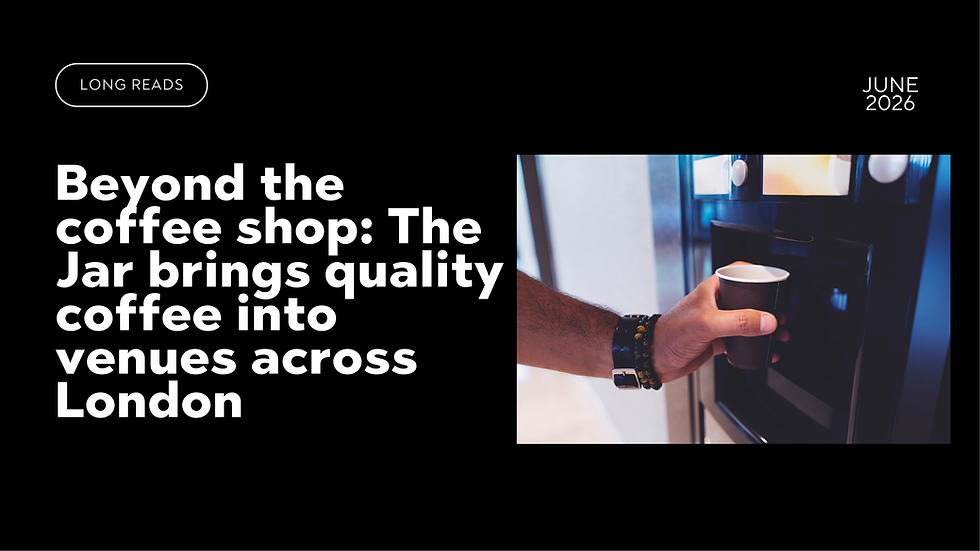
Beyond Vending: How shared spaces in London are rethinking everyday convenience

September 2026
London has increasingly become a city built around convenience. From next-day delivery to beyond-vending-how-shared-spaces-in-london-are-rethinking-everyday-convenienceon-demand food and groceries, consumers have become accustomed to accessing what they need quickly and with very little friction.
The Covid-19 pandemic accelerated many of these behaviours, but they did not disappear when people returned to workplaces, shared spaces and in-person life. If anything, expectations around convenience have become embedded in everyday life.
For workplaces, co-living spaces, hospitals and other shared environments, this creates an interesting question:
Should people always need to leave the building, or order a delivery, to access everyday essentials?
Traditionally, vending helped answer this need through snacks and drinks. Increasingly, however, unattended retail is capable of providing much more. In this Long Read, we explore how expectations around convenience are changing, why vending is expanding beyond food and drink, and how The Jar Healthy Vending is broadening its own role beyond the traditional vending machine.
Convenience has become an expectation for Londoners
London life is increasingly shaped by competing demands on people’s time. Work, family, social commitments, fitness and everyday household tasks all compete for attention, making convenience an increasingly important part of how people access goods and services.
At the same time, e-commerce and rapid delivery services have changed expectations around speed. Next-day and even same-day delivery is now commonplace for many everyday purchases.
Amazon, for example, reported in February 2026 that more than 1.6 billion items had been delivered to UK Prime members on the same or next day during 2025. It had also launched a 30-minute grocery and household delivery service in parts of London.
Some of the most commonly ordered same-day products included everyday essentials such as coffee pods, oat drinks, toilet paper, baby wipes and pet food, alongside vitamins and other health and wellbeing products.
This tells us something important: convenience is no longer limited to takeaway food or occasional purchases. Consumers increasingly expect even relatively ordinary household essentials to be accessible quickly.
From delivery to availability
The next stage of convenience may not always mean an even faster delivery to the front door. In workplaces, co-living buildings, hospitals and other shared environments, convenience can also mean making frequently needed products available within the building itself.
Rapid delivery has transformed consumer expectations, but it also raises questions around additional journeys, packaging and the operational cost of fulfilling individual orders.
On-site provision offers a different approach. Rather than each person individually ordering an everyday item when they need it, a shared retail point can make commonly required products immediately available where demand already exists. In other words, convenience can move from delivery to availability.
Vending is moving beyond food and drink
Traditionally, vending has been associated primarily with packaged snacks and drinks. Today, unattended retail technology can accommodate a much broader range of products.
Depending on the environment, this could include:
toiletries and personal-care products
household essentials
laundry products
PPE and workplace equipment
stationery and workplace consumables
electronic accessories and chargers
clothing or other site-specific products
This opens up a much wider role for vending. Rather than asking simply, “Which snacks should go in this machine?”, operators and venue managers can instead ask:
“What do the people using this space regularly need?”
That is a very different starting point.

Different spaces need different solutions
More than ten years of experience across different venue types has shown us that convenience is highly dependent on context. What is useful in a co-living development may be completely different from what someone needs during a shift in a warehouse or an overnight stay in a hospital.
For example:
Co-living spaces
Residents may value access to toiletries, laundry detergent, household essentials and personal-care products without having to leave the building.
Workplaces
Useful items might include stationery, chargers, personal-care products and other essentials that are easily forgotten during the working day.
Warehouses & industrial sites
PPE and practical workplace essentials can be made available directly to the people who need them.
Hospitals & healthcare environments
Food and drink can sit alongside toiletries and personal-care products, particularly where people may be on site for long periods or outside normal retail opening hours.
Gym & leisure facilities
Hygiene products, towels, sports accessories and other useful essentials can complement the traditional food and drink offer.
The important point is that there is no single definition of convenience. The right provision depends on the people who are using the building.
The changing role of a vending supplier
For us, this shift has meant rethinking what a vending supplier can actually provide. The role is no longer necessarily limited to installing a machine and replenishing snacks. Increasingly, it is about understanding the site, identifying gaps in provision and creating a service around the people who use that space.
Sometimes the right answer will still be a conventional vending machine. In other environments, it could mean a smart fridge, freezer or unattended retail solution stocked with different types of products. And in some cases, it may not involve vending at all.
Beyond the machine
At The Jar, our own service has expanded alongside these changing requirements. As well as supplying food and drink through our vending machines, smart fridges and freezers, we can also support clients with wider consumables and wholesale products for use elsewhere within their buildings.
Depending on the site, this can include services such as unpacking, merchandising and helping clients manage products that sit outside of the vending offer itself.
For us, this is an important part of what “beyond vending” means. The machine may still be the most visible part of the service, but it does not necessarily have to be the limit of what a vending supplier can provide.
Convenience without another delivery
Consider something as simple as toothpaste, laundry detergent or a phone charger. If someone suddenly needs one of these products, the usual response might be to leave the building and find a shop or place an individual online order.
A shared retail point creates another option: keeping commonly required essentials available for many occupants in one location.
This does not automatically make on-site provision more sustainable or appropriate in every setting. But it raises an interesting question about where convenience could be heading:
Could the future of convenience be less about delivering everything individually and more about making the right products available in the right places?
For shared spaces, that is an increasingly relevant question.
Go Beyond Vending with The Jar Healthy Vending
Convenience has changed. People increasingly expect products and services to fit around where they already live, work and spend their time. For workplaces, co-living developments, hospitals, warehouses and other shared environments, this creates an opportunity to think differently about what should be available on site.
Vending may still be part of that answer, but increasingly, it is only one part. At The Jar, we see the future as less about simply filling machines and more about understanding what each space actually needs.
The machine may be where the service starts. It does not have to be where it ends.